The regulation of facade colors in France does not rely on any national color chart. Each municipality, each protected area imposes its own chromatic prescriptions, often unknown to project owners until their preliminary declaration is rejected. Understanding the mechanics of these prescriptions can prevent months of administrative blockage.
Binding color charts in PLUs: NCS and RAL references
In recent years, we have observed a clear tightening of chromatic prescriptions in urban planning documents. Many PLUs and Remarkable Heritage Sites (SPR) no longer settle for “recommended” palettes: they incorporate binding color charts with specific NCS or RAL references.
The case of Saint-Etienne-de-Baïgorry illustrates this trend. Its PLU, by order of November 17, 2025, annexes a general palette mentioning specific NCS shades (S 0505-Y30R, S 1510-Y30R, S 2005-Y40R, among others). These codes are not indicative: they have regulatory value and condition the granting of work authorization.
In practical terms, this means that a coating whose shade deviates from the prescribed reference can lead to a refusal, even if the nuance appears visually close. We recommend asking the town hall not for “the authorized colors,” but for the graphic document annexed to the PLU, which is the only valid reference. The Urbanism Geoportal (data.geopf.fr) allows access to these annexes for municipalities that have digitized them.
To better understand the authorized colors for buildings in France, one must reason on a municipality-by-municipality basis and not seek a national list that does not exist.
Facades in ABF perimeter: opinion mechanism and negotiation margin
In the vicinity of historical monuments or in an SPR, the Architect of the Buildings of France (ABF) issues an opinion on any modification of the exterior appearance. This opinion is binding in SPRs and around monuments, meaning that the mayor cannot override a refusal.
The ABF does not work blindly. Several DRACs have published advisory sheets and reference brochures to objectify the prescriptions and limit decisions perceived as arbitrary. The DRAC Centre-Val de Loire, for example, publishes an advisory sheet “The Colors” that details the heritage ranges by type of building.
Anticipating dialogue with the ABF
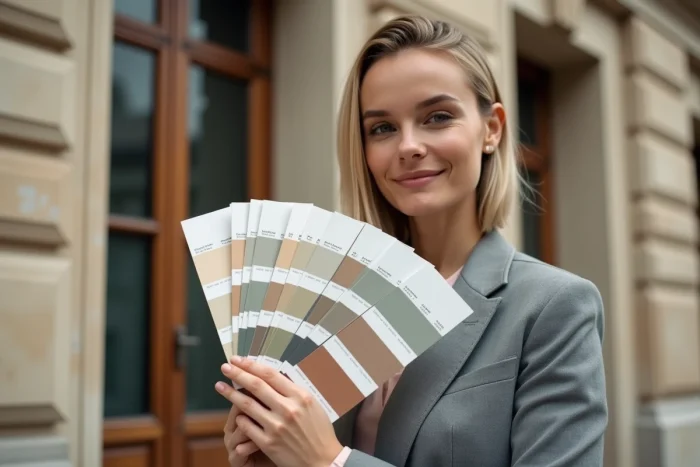
We recommend requesting a meeting prior to submitting the declaration. The ABF can guide the color choice in advance and avoid a formal refusal. Presenting a physical sample (rendering panel, NCS color chart) rather than a simple code on paper speeds up validation.
There is room for negotiation, but it concerns variations within the local palette, not shades outside the register. A slightly darker ochre may be accepted, but an electric blue will not.
External thermal insulation and chromatic constraints
External thermal insulation (ITE) modifies the appearance of the facade and systematically triggers a chromatic conformity obligation. In ABF areas, ITE is often refused on facades visible from public space, as it alters the modulation and thickness of window frames.
The DRAC Centre-Val de Loire specifies that the shades of coating must both respect the heritage ranges and limit the heating of highly exposed facades. In areas subject to recurring heat waves, light and matte tones are favored to reduce thermal absorption.
Balancing energy performance and heritage
This point creates frequent tensions between project owners and regulatory services. The owner wants a contemporary dark shade, while the prescription imposes a light stone tone. The solution often involves differentiated treatment of facades: heritage coating on the street side, more flexible finishing on elevations not visible from the public domain.
Joinery and ironwork: the forgotten prescriptions
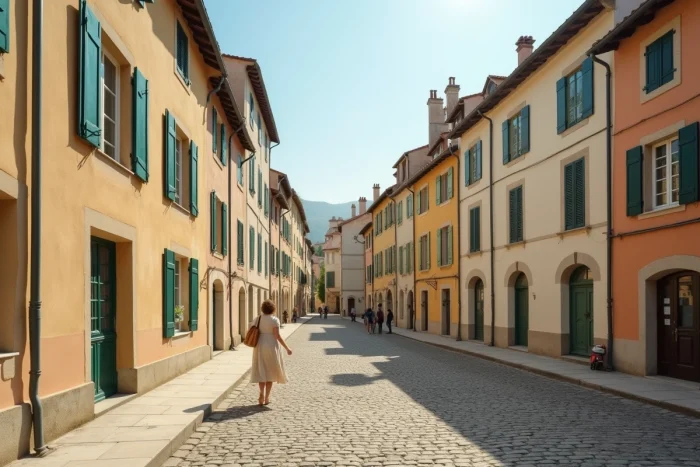
Facade colors are not limited to the coating. Exterior joinery (shutters, windows, doors) and ironwork elements are subject to distinct prescriptions in most PLUs and recommendation booklets.
- Shutters and storm shutters generally follow a limited palette related to the building typology: gray-blue in Touraine, dark green in Normandy, blood-red in certain areas of the Southwest.
- Painted wooden windows often adhere to a single shade per municipality, sometimes two depending on the building’s construction period.
- Ironwork (guardrails, hinges, locks) is prescribed in black, graphite gray, or dark brown according to the local CAUE sheets.
The CAUE 37 (Indre-et-Loire) reminds us that some urban planning regulations precisely define the shades usable for joinery, and that several municipalities have annexed a dedicated color chart to their PLU. Checking this document before purchasing paint avoids a refusal upon completion of the work.
Practical steps before choosing a facade color
The chromatic validation process follows a precise order, and circumventing it exposes one to sanctions (notice to restore, fine).
- Consult the PLU regulations of the municipality, particularly its graphic annexes (color chart, prescription palette).
- Check if the building is located in a protection zone (surroundings of historical monuments, SPR, AVAP, ZPPAUP) via the Heritage Atlas.
- Contact the town’s urban planning service or directly with the UDAP (Departmental Unit of Architecture and Heritage) to obtain the applicable prescriptions.
- Submit a preliminary declaration of works explicitly mentioning the chosen shade (NCS or RAL reference), accompanied by a sample if possible.
A coating applied without authorization in a protected area may lead to a requirement to restore it at the owner’s expense, even if the chosen shade would have been accepted upon prior request. The procedure is as important as the chromatic choice itself.
The regulatory framework for facade colors is gradually being structured around binding color charts and increasingly technical prescriptions. Treating the issue of color as a mere aesthetic choice ignores an entire aspect of the processing of urban planning authorizations.