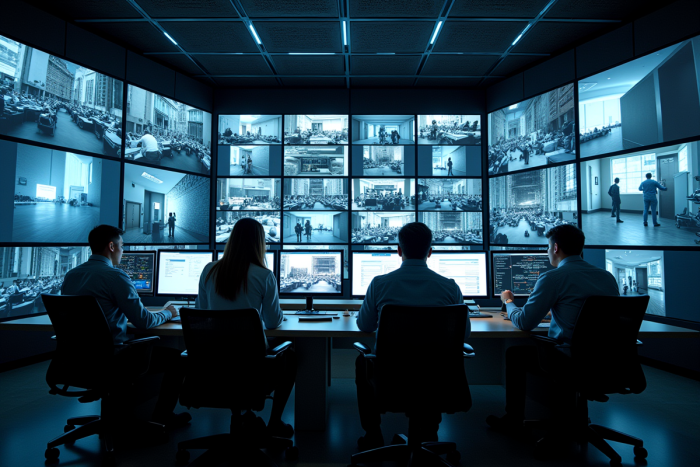
Private security companies are increasingly integrating technological innovations to optimize their operations. Smart cameras, equipped with facial recognition and behavioral analysis, allow for more precise and responsive surveillance. Drones provide extensive and rapid coverage of sensitive areas, thereby reducing the risks of intrusion.
Centralized management software facilitates the coordination of teams in the field, enabling increased responsiveness to incidents. Mobile applications give agents instant access to critical information, enhancing their efficiency and ability to make informed decisions on the ground.
New Technologies in the Service of Private Security
Private security is undergoing a profound transformation thanks to the integration of new technologies. Drones, remote surveillance, and SaaS software are transforming the management and efficiency of private security agencies. The SEKUR® software is a prime example: it allows for centralized administration of operations, thus facilitating the coordination of teams in the field.
Enhanced Security Agents
Security agents directly benefit from these technological advancements. The use of artificial intelligence helps them analyze complex situations in real-time. Facial recognition, integrated into surveillance systems, allows for the quick identification of suspicious individuals. Mobile applications, such as ‘my Securitas portal’, provide agents with immediate access to essential data, thereby enhancing their responsiveness and effectiveness.
- Drones: extensive and rapid surveillance
- Remote surveillance: centralized and real-time management
- SaaS software: simplified and efficient administration
Optimized Management Through Technological Innovations
Cutting-edge technologies optimize risk management and infrastructure protection. The 5G network, for example, allows for the remote operation of security vehicles, offering greater operational flexibility. The Strategic Committee for the Security Industry, established by the Minister of Economy in 2018, brings together industry players to promote these innovations and their integration into daily practices.
Private security agencies must now adapt to these new trends to remain competitive and meet the growing demands for security. Private security companies that integrate these technologies into their work environment not only improve their operational efficiency but also enhance their ability to anticipate and manage threats. 
Management Optimization Through Technological Innovations
Optimizing management in the private security sector involves a massive adoption of new technologies. The SEKUR® software, a comprehensive SaaS, stands out for its ability to centralize operations and facilitate team coordination. Its use allows for better resource allocation and smoother management of security missions.
A Structural Reorganization
Private security companies are reorganizing their internal structure to integrate these innovations. Pascal Pech, president of SNES, emphasizes that the digitization of administrative and operational processes reduces human errors and increases responsiveness. Scheduling, task distribution, and intervention tracking are now automated, providing significant time savings.
Advanced Technologies for Enhanced Security
Artificial intelligence plays a central role in improving security services. Dominique Legrand, president of ANV2, highlights the use of AI for predictive risk analysis. This approach allows for the anticipation of threats and the more strategic deployment of security agents.
- Predictive analysis: threat anticipation
- Task automation: reduction of human errors
- Data centralization: simplified management
5G and Cybersecurity
Servan Lépine, CEO of Excelium, stresses the impact of the 5G network in private security. 5G enables instant communication and remote operation of surveillance equipment. However, this technological advancement requires increased vigilance regarding cybersecurity to protect sensitive data of companies and individuals. Security agencies must invest in robust systems to counter cyberattacks and ensure the confidentiality of information.