Whether it’s to follow a recipe found online or to adapt a preparation to your own tastes, conversions in cooking can quickly become a headache. Converting grams to ounces, milliliters to cups, or adjusting proportions for a different number of guests requires precision and attention. A conversion error can easily ruin a dish, turning a promising evening into a culinary disaster.
You need to know some basic tips and avoid certain common mistakes. Using reliable conversion tools, understanding the differences between measurement systems, and always double-checking your calculations are major steps to succeed in the kitchen.
Understanding Measurement Units and Their Equivalences in Cooking
The kitchen is an area where measurement units play a fundamental role. To avoid mistakes, it is necessary to master the equivalences between different units.
Volumes
In cooking, volume can be expressed in liters, milliliters, or centiliters. For example, 1 liter (l) is equivalent to 100 centiliters (cl) or 1000 milliliters (ml). For those wondering about volume conversions, the question of 300 ml to cl is common and deserves special attention: 300 ml is equivalent to 30 cl.
- 1 tablespoon in France contains about 15 ml.
- 1 tablespoon in the United States contains about 20 ml.
- 1 teaspoon contains about 5 ml.
Weights
For solid ingredients, weight is often measured in kilograms, grams, or ounces. One ounce is approximately 28.35 grams. These conversions are essential for adapting international recipes.
Temperatures
Converting temperatures is also fundamental. To convert from Fahrenheit to Celsius, use this formula: (°F – 32) x 5/9 = °C. Mastering these conversions ensures you won’t miss the cooking of your dishes.
Master these conversions to avoid common mistakes and ensure precise and tasty cooking. 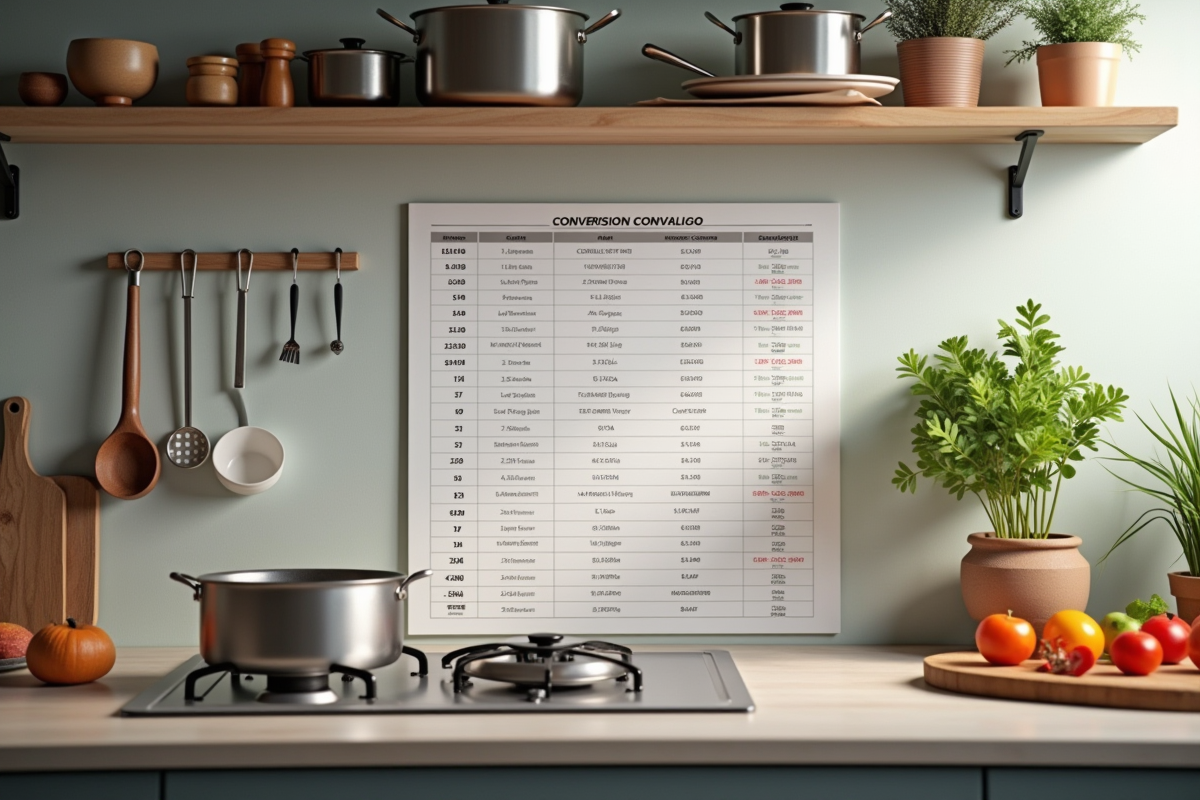
Techniques and Tools for Accurate and Error-Free Conversions
Mobile Apps and Websites
Mobile apps and specialized websites offer practical solutions for immediate conversions. These digital tools allow you to quickly convert volumes, weights, and temperatures. Use these apps to avoid mistakes and save time in the kitchen.
Measuring Utensils
The use of appropriate measuring utensils is essential for accurate conversions. Here are some examples of indispensable utensils:
- Measuring cup: ideal for measuring liquids accurately.
- Kitchen scale: allows you to weigh solid ingredients precisely.
- Kitchen thermometer: useful for checking cooking temperatures.
- Measuring spoons: ensure accurate measurements for small quantities.
Cookbooks and Conversion Charts
Cookbooks often include conversion charts that facilitate recipe adaptation according to the available measurement units. These charts are particularly useful for cooks working with international recipes.
By adopting these techniques and tools, you can avoid common mistakes and ensure the accuracy of your culinary preparations.