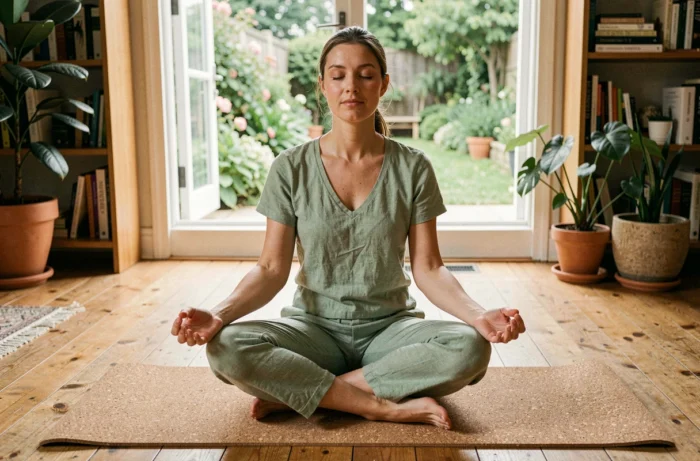
Yoga and mindfulness share a common physiological foundation: regulating the autonomic nervous system through breath control. Cultivating everyday well-being through these two practices means understanding how they work, their documented limitations, and the conditions under which they produce a measurable effect on stress, sleep, and emotional balance.
Vagal tone and pranayama: the mechanism mainstream guides gloss over
Slow breathing, particularly the prolonged exhalations typical of controlled-ratio pranayama, stimulates the vagus nerve and shifts the nervous system toward parasympathetic dominance. This shift lowers heart rate and circulating cortisol, and changes heart rate variability (HRV), a marker of the body’s ability to adapt to stress.
Not all yogic breathing techniques have the same effect. Energizing techniques (kapalabhati, bhastrika) increase sympathetic activity. Equating “yogic breathing” with “relaxation” ignores the fact that pranayama is a two-way tool whose effects depend on the chosen inhalation-retention-exhalation ratio.
For everyday well-being, experienced practitioners favor a ratio in which the exhalation lasts at least twice as long as the inhalation, without forced breath retention. This simple guideline is enough to activate the vagal branch within minutes, even off the mat—in a professional setting or while commuting.
Our review of recent literature found that a systematic review published in Frontiers in Psychiatry in 2024 confirmed a reduction in perceived stress among stressed adults compared with groups receiving no intervention, while rating the evidence as low quality. This caveat means yoga should be presented as a complementary tool, not a standalone treatment.
Explore well-being at Les Jardins Du Yoga to discover these breathing techniques in a structured setting, with progressions suited to each practitioner’s level.
Adverse effects of mindfulness meditation: adapt rather than push through
Mindfulness meditation is not beneficial for everyone in the same way. A systematic review published in 2020 in Acta Psychiatrica Scandinavica identified possible adverse effects: anxiety, depressed mood, and cognitive disturbances. These effects affect a minority of practitioners, but their existence challenges the claim that meditation carries no risks.
Three situations call for adapting the practice or taking a temporary break:
- An increase in anxiety during or after sessions that lasts more than a few minutes, especially in people with a history of generalized anxiety disorder.
- Episodes of depersonalization or derealization, sometimes triggered by long meditation sessions (over twenty minutes) in beginners without guidance.
- Increased rumination: the instruction to observe thoughts without judgment can reinforce the cycle of rumination in some people rather than interrupting it.
The appropriate response is to shorten sessions, favor guided meditations with a sensory anchor (body scan, focusing on a sound), and consult a mental health professional if distress persists. Adapting the practice is always better than abandoning it or forcing yourself to continue.
Yoga and sleep: what research can actually tell us
A review published in 2020 in BMC Psychiatry suggests that yoga may improve sleep quality in some populations. The American Academy of Sleep Medicine’s clinical recommendations do not position yoga as a standalone treatment for insomnia; they prioritize cognitive behavioral therapy for insomnia (CBT-I).
Yoga affects sleep through two complementary pathways. The first is reducing pre-sleep cognitive hyperarousal through slow-breathing techniques and restorative poses (viparita karani, supta baddha konasana). The second is regulating the circadian rhythm through regular morning practice, which reinforces the wake-up signal and, in turn, helps you fall asleep in the evening.
Adding a short restorative yoga sequence before bed can complement a CBT-I protocol, but it does not replace it. Articles that present yoga as a miracle cure for insomnia rarely make this distinction.

Daily yoga and mindfulness routine: what makes a practice sustainable
Consistency matters more than duration. A daily practice of ten to fifteen minutes produces more stable effects on stress management than a seventy-five-minute weekly session. The key factor is the frequency of parasympathetic nervous system activation, not the total amount of practice.
Three factors help structure a sustainable routine:
- A set time linked to an existing behavior (after waking and before showering, after lunch, or before bed) to build the habit without having to make a decision.
- Content that can be adjusted to suit how you feel that day: a dynamic sequence (short vinyasa) when mentally tired, a restorative sequence when physically tense, or seated meditation when emotionally overwhelmed.
- A non-negotiable minimum: even three minutes of mindful breathing keeps the practice going and helps prevent you from giving up after a busy day.
When practiced regularly and mindfully, yoga is a form of active prevention rather than repair.
What sets a lasting routine apart from a passing enthusiasm is the ongoing adjustment. A pose that causes joint pain should be modified or dropped. A meditation that makes you feel restless should be shortened or replaced with a breathing exercise. The goal remains the same: to stay connected with body and breath awareness every day, without turning the practice into another burden.