The spring-summer 2026 accessories are viewed through two lenses: the color palette (acacia yellow, nature greens, desaturated pastels) and the return of versatile pieces like the scarf or soft belt. Rather than piling on trends, we detail here the technical choices that separate a sustainable accessory from an outdated impulse buy by September.
Acacia yellow and nature greens: choosing accessories by color
The acacia yellow, a bright yellow slightly tinged with green, dominates the accessory collections this season. Its strength lies in its compatibility with neutral bases: a bag or scarf in this shade is enough to refresh a monochrome wardrobe without needing to buy new statement pieces.
The nature-inspired greens follow the same logic. Caps, belts, and clutches in these tones work as accents on office core or minimalist silhouettes. A common mistake is to pair two accessories of the same bright hue: the result unbalances the outfit instead of structuring it.
We recommend limiting the strong color to a single visible accessory per look. An acacia yellow bag is enough; the rest should remain neutral. Desaturated pastels (pale lilac, glacier blue) serve as a bridge if you want a second point of color without visual saturation.
To browse the accessories for sale on Mlle, filtering by color allows you to quickly spot pieces that fit within this palette without multiplying unnecessary purchases.
Multi-use scarf: tying techniques and fabric criteria
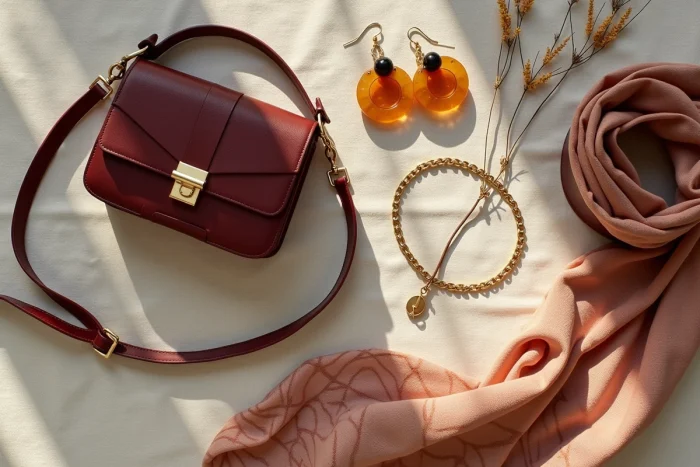
The scarf is making a strong comeback this season, worn in an 80s style but with much broader uses than just a neck wrap. Tied on the handles of a bag, as a headband, or folded into a high-waisted belt, it replaces several accessories on its own.
Which fabric for which use
The material determines the hold of the knot. A silk twill square keeps its shape on a bag handle but slips in the hair. A lightweight cotton holds better as a headband, but it wrinkles quickly around the waist. Viscose-linen blends offer a decent compromise for versatile use.
- As a headband: favor a matte fabric with minimal grip (cotton, linen) and a width of 60 to 70 cm for a stable knot.
- On a bag: a twill or satin square is sufficient; the rigidity of the fabric creates volume and movement.
- As a high-waisted belt: opt for a rectangular piece rather than a square; the extra length facilitates a double wrap and a flat knot.
A single well-chosen scarf replaces three seasonal accessories. It is one of the pieces with the best versatility-price ratio in the 2026 wardrobe, provided you do not choose a print that is too bold, which limits combinations.
Unisex accessories: the convergence of men’s and women’s fashion in 2026
The spring-summer 2026 collections accelerate the movement towards unisex accessories. On the men’s side, trends now incorporate historically feminine pieces (thin scarves, soft small bags), while women’s lines borrow wide-case watches and technical caps.
This convergence is not just aesthetic. It has a direct implication for purchasing: a well-selected unisex accessory can be shared within a household, justifying investment in higher quality. Brands that offer a unique sizing or two simple sizes (S/M, L/XL) facilitate this approach.
Most relevant dual-use pieces
- Faded cotton or linen caps: the five-panel format with a short visor fits most body types without gender adjustment.
- Soft leather braided belts: the simple pin buckle, without visible logo, works on high-waisted pants as well as on chinos.
- Crossbody bags in canvas or grainy leather, A5 size: compact enough for daily use, subtle enough not to mark a masculine or feminine wardrobe.
The key selection criterion remains the absence of strong gender markers (oversized logo, ornamental buckle, candy pink or navy blue “suit” colors). Nature tones and matte finishes adapt to all styles.
Steel jewelry and stacking: the accumulation rules this season
Stainless steel jewelry continues to gain ground against gold-plated and silver options, primarily for their resistance to oxidation and compatibility with daily wear. Stacking (layering rings, bracelets, or necklaces) remains a strong trend, but the 2026 collections set clearer limits than the maximal accumulation seen in previous seasons.
We observe a return to controlled stacking: three pieces maximum on the same body point. Two thin rings on the same hand, a choker paired with a longer chain. Beyond that, the effect becomes heavy, especially with the dominant minimalist silhouettes this season.
Combining steel and gold metal
The mix of gold and silver, long considered a faux pas, is now common. The technical condition for the result to work: maintain an unbalanced ratio, about two-thirds of one metal and one-third of the other. A 50/50 balance gives an indecisive effect. Choosing a dominant metal and using the other as an accent creates a readable contrast.
Earrings follow the same logic. The oversized formats from the runways give way to medium hoops or geometric studs that are more wearable daily. Brushed steel, less shiny than polished, integrates better into daytime outfits.
Choosing an accessory this season comes down to balancing versatility and visual impact. The most durable pieces in a wardrobe are those that work across multiple outfits and contexts, not those that catch the eye once before ending up in a drawer.